Climate and Democracy
Annual Theme 2024
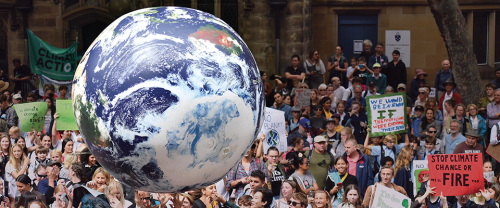
Since its birth in revolutions that swept the Atlantic world two centuries ago, modern democracy has developed under a relatively stable, if gradually warming, global climate. Now, even as they are beset by a diverse set of challenges – including right-wing populism, increasingly powerful authoritarian regimes, forms of media susceptible to disinformation campaigns, the impacts of the pandemic, and mass migrations sparked by environmental stresses, political instability, and economic inequality – the world’s democracies must also face accelerating climate change as it intersects with these other pressures in unpredictable and potentially devastating ways. In its 2023-24 theme year, Climate and Democracy, the Andrea Mitchell Center partners with the Penn Program in Environmental Humanities, with support from the Penn Environmental Innovations Initiative and the SAS Dean's Office, to explore the risks posed by climate change to democratic norms, as well as the capacity of democratic institutions to address the issue. And while it is possible to imagine a future in which natural disasters and democratic failures compound one another, we are asking how climate solutions and democratic values might reinforce each other and lead to greater political and environmental resilience.
Climate and Democracy: Alliances Amidst Uncertainty
PCPSE AUDITORIUM (LOWER LEVEL)
Green New Deal Realities: Insights from the US, Germany, and Beyond
Online: Zoom event
Voices for Change: Empowering Climate Change Communicators
PCPSE 250 (the Forum)
Fossil Fuels and Autocrats, in Russia and Beyond
133 S. 36th Street, Room 250 (Forum)
In-person and online.
Zoom link sent to registered attendees.

Energy Justice in a Climate-Changing World
133 S. 36th Street, Room 250 (Forum)
In-person and online.
Zoom link sent to registered attendees.

Youth-Driven Climate Action: Power and Potential
133 S. 36th Street, Room 250 (Forum)
In-person and online: Zoom link sent to registered attendees.

2023-24 "Climate and Democracy" Graduate Fellows
In order to deepen our understanding on this vital topic, the Mitchell Center and PPEH have awarded Climate and Democracy Graduate Fellowships to five Penn graduate students, who will meet throughout the year to work on collaborative projects. The recipients are Tayeba Batool (Anthropology), who studies nature-based urban planning in Pakistan; Sarah Eskandari (History), who studies the intersection of women, environmentalism, and revolution in Iran; Helene Langlamet (Communication), who studies the ways in which the coal and natural-gas lobbies shape politics in western Pennsylvania; Rehana Thembeka Odendaal (Education), who studies youth climate activists in the U.S. and South Africa; and Vanessa Schipani (Philosophy), who studies the roles of science and science journalism in shaping democratic deliberation over climate policy.
"Climate and Democracy" Planning Committee
The members of the “Climate and Democracy” planning committee are Bethany Wiggin, Chair (Penn Germanic Languages and Literatures; Founding Director, Penn Program in Environmental Humanities), Marge Bruchac (Penn Anthropology), Brenda Casper (Penn Biology), Elizabeth Ellis (Princeton History), Jeffrey Green (Political Science; Director, Andrea Mitchell Center), Michael Mann (Penn Earth and Environmental Science), Lisa Mitchell (South Asia Studies), Eric Orts (Wharton Legal Studies and Business Ethics), Gwen Ottinger (Drexel Dept. of Politics; Center for Science, Technology and Society), Jennifer Pinto-Martin (Penn Nursing; Perelman School of Medicine), Matthew Roth (Andrea Mitchell Center), and Paul Saint-Amour (Penn English).