Past Events
Room 350, Perelman Center for Political Science and Economics (133 S. 36th Street)
Hybrid in-person/online event
Please register here. Zoom link and links to papers sent to registrants.
Trust Fund Families: Family Bureaucratization and Elite Social Reproduction

Doron Shiffer-Sebba (Penn Sociology)
BEYOND ALLOCATING MATERIAL RESOURCES UNEQUALLY BY SOCIAL CLASS, the state also reproduces class structures by funneling families with similar class backgrounds into similar experiences with state institutions (e.g., welfare programs, government bureaucracies, the criminal justice system). Scholars have long demonstrated how the state performs this role in the social reproduction of middle class and poor families. But its role reproducing elite status through contact with state institutions has scarcely been examined. DORON SHIFFER-SEBBA uses six months of ethnographic observations at an office that manages the financial affairs of top 0.1% wealthy elites to understand how the state shapes the lives of elites in the domain of financial management. He finds that a central way the state influences their experiences is by incentivizing them to manufacture a wide range of legal entities such as trusts, corporations, and foundations, to pursue goals like tax minimization. These entities, in turn, bureaucratize relationships between family members and create new forms of privilege within elite families, including what I call “financial multi-personhood”. Far from being absent in the lives of elites, the state shapes both how elites reproduce their class vis-à-vis other social classes, and how privilege is distributed internally within elite families.
Colonial Genealogies of Consociation: Pluralism, Leadership, and the Price of Peace in Contemporary Democratic Theory
Joy Wang (Yale Political Science)
IN THE DECADES OF FORMAL DECOLONIZATION FOLLOWING the Second World War, anticolonial political thinkers sought to realize democratic self-determination through proposals for federated representation, universal suffrage and directed association. JOY WANG chronicles how political scientists went in a different direction, as they reconfigured accounts of social pluralism that had once been deployed to defer demands for popular sovereignty into institutional proposals for the preservation of social peace after empire. Democratic theorists such as David Apter and Arend Lijphart mined interwar studies of colonial administration to advance proposals for stability maintenance through elite cooperation and power-sharing, in what has become formalized as “consociational” democracy and its federal and confederal variants. Hence where democratic theorists have criticized consociational democracy for its tendency to reify social difference, Wang argues that reconstruction of a specifically late-colonial genealogy for democratic theory should instead alert us to its reliance upon elite bargaining and leadership for the curtailing of popular demands in the service of continued social peace.
GRAD WORKSHOP - Dynamics of Elite Self-Preservation
Room 350, Perelman Center for Political Science and Economics (133 S. 36th Street)
Hybrid in-person/online event
Please register here. Zoom link and links to papers sent to registrants.
Trust Fund Families: Family Bureaucratization and Elite Social Reproduction
Doron Shiffer-Sebba (Penn Sociology)
BEYOND ALLOCATING MATERIAL RESOURCES UNEQUALLY BY SOCIAL CLASS, the state also reproduces class structures by funneling families with similar class backgrounds into similar experiences with state institutions (e.g., welfare programs, government bureaucracies, the criminal justice system). Scholars have long demonstrated how the state performs this role in the social reproduction of middle class and poor families. But its role reproducing elite status through contact with state institutions has scarcely been examined. DORON SHIFFER-SEBBA uses six months of ethnographic observations at an office that manages the financial affairs of top 0.1% wealthy elites to understand how the state shapes the lives of elites in the domain of financial management. He finds that a central way the state influences their experiences is by incentivizing them to manufacture a wide range of legal entities such as trusts, corporations, and foundations, to pursue goals like tax minimization. These entities, in turn, bureaucratize relationships between family members and create new forms of privilege within elite families, including what I call “financial multi-personhood”. Far from being absent in the lives of elites, the state shapes both how elites reproduce their class vis-à-vis other social classes, and how privilege is distributed internally within elite families.
Colonial Genealogies of Consociation: Pluralism, Leadership, and the Price of Peace in Contemporary Democratic Theory
Joy Wang (Yale Political Science)
IN THE DECADES OF FORMAL DECOLONIZATION FOLLOWING the Second World War, anticolonial political thinkers sought to realize democratic self-determination through proposals for federated representation, universal suffrage and directed association. JOY WANG chronicles how political scientists went in a different direction, as they reconfigured accounts of social pluralism that had once been deployed to defer demands for popular sovereignty into institutional proposals for the preservation of social peace after empire. Democratic theorists such as David Apter and Arend Lijphart mined interwar studies of colonial administration to advance proposals for stability maintenance through elite cooperation and power-sharing, in what has become formalized as “consociational” democracy and its federal and confederal variants. Hence where democratic theorists have criticized consociational democracy for its tendency to reify social difference, Wang argues that reconstruction of a specifically late-colonial genealogy for democratic theory should instead alert us to its reliance upon elite bargaining and leadership for the curtailing of popular demands in the service of continued social peace.
Perelman Center for Political Science and Economics
133 S. 36th Street, Auditorium (Basement Level)
Please register here.
Join the five caucuses of the Penn Political Union (PPU) for a debate on the resolution, "President Biden was right to withdraw troops from Afghanistan."
The PPU is unique among debating societies in encouraging participants to make heartfelt cases for policies they believe in to a politically diverse group of fellow students. Members can join one of five caucuses that span the political spectrum: Progressive, Liberal, Centrist, Conservative, and Libertarian. They can then take active roles in formal debates on important policy problems. At a time of political polarization and social-media bubbles, it is an opportunity to hone and challenge one’s own opinions, as well as make friendships “across the aisle” and cultivate the practices of civil discourse.
PPU DEBATE - Was the Withdrawal from Afghanistan the Right Thing to Do?
Perelman Center for Political Science and Economics
133 S. 36th Street, Auditorium (Basement Level)
Please register here.
Join the five caucuses of the Penn Political Union (PPU) for a debate on the resolution, "President Biden was right to withdraw troops from Afghanistan."
The PPU is unique among debating societies in encouraging participants to make heartfelt cases for policies they believe in to a politically diverse group of fellow students. Members can join one of five caucuses that span the political spectrum: Progressive, Liberal, Centrist, Conservative, and Libertarian. They can then take active roles in formal debates on important policy problems. At a time of political polarization and social-media bubbles, it is an opportunity to hone and challenge one’s own opinions, as well as make friendships “across the aisle” and cultivate the practices of civil discourse.
Auditorium, Perelman Center for Political Science and Economics
133 S 36th St, Basement Level
Hosted by the Middle East Center

TWENTY YEARS HAVE PASSED SINCE THE TRAGIC EVENTS of September 11, 2001. Join us for this special retrospective discussion of the many ways the world has been changed, challenged, and reconfigured by the fallout from this historic moment.
SPENCER ACKERMAN is a contributing editor and former senior national security correspondent for The Daily Beast. He is the author of REIGN OF TERROR: How The 9/11 Era Destabilized America and Produced Trump (Viking, 2021). The former U.S. national security editor for the Guardian, Ackerman was part of the Pulitzer Prize-winning team reporting on Edward Snowden's surveillance revelations.
DR. TESNEEM ALKIEK earned her Ph.D. in Islamic Studies with a focus on the development of Islamic law from Georgetown University. She completed her undergraduate degree in Early Christianity and Islamic Studies at the University of Michigan. Tesneem serves as the Director of Expanded Learning at the Yaqeen Institute where she works with her team to create curricula and other resources for communities to engage with the latest research on Islam.
COL. VINCENT CIUCCOLI is a Marine Corps officer with extensive deployment experience in the Middle East and North Africa. From 2010 to 2012, he acted as the lead operations desk officer for Iraq and the Deputy Team Leader for NATO’s Operation Unified Protector in Libya. In 2015-2016, he studied at Israel's National Defense College, and was subsequently deployed by CENTCOM in support of Operation Inherent Resolve. Col. Ciuccoli is Commanding Officer of the Philadelphia Consortium NROTC.
CAROL KALIN is a twenty-year veteran of the U.S. Foreign Service. She has served in Lebanon, Egypt, and Saudi Arabia, and was Deputy Chief of Mission at the U.S. Embassy in Beirut on September 11, 2001. She taught Critical Writing at Penn beginning in 2013.
HAZAMI SAYED is founder of Al-Bustan Seeds of Culture, Philadelphia's most prominent Arab-American cultural organization. Originally from Lebanon, Sayed was trained as an architect and founded Al-Bustan in the aftermath of September 11, 2001, in an attempt to cultivate a positive image of Arab-American culture as an inspiration for her two young children.
PLEASE NOTE: in accordance with the University of Pennsylvania's current COVID-19 guidelines, the Middle East Center is planning to hold this event in person. It is MANDATORY for all attendees to wear masks. Physical distancing will be observed. All attendees must sign a special event sign-in sheet, attesting that they have been fully vaccinated for COVID-19 or are a Penn community member enrolled in the Penn Cares testing program. We will continue to monitor CDC, city, and university guidelines and will move this event online if it is deemed necessary for the protection and safety of our community.
CO-SPONSORED - Twenty Years Later: The Legacy of 9/11
Auditorium, Perelman Center for Political Science and Economics
133 S 36th St, Basement Level
Hosted by the Middle East Center
TWENTY YEARS HAVE PASSED SINCE THE TRAGIC EVENTS of September 11, 2001. Join us for this special retrospective discussion of the many ways the world has been changed, challenged, and reconfigured by the fallout from this historic moment.
SPENCER ACKERMAN is a contributing editor and former senior national security correspondent for The Daily Beast. He is the author of REIGN OF TERROR: How The 9/11 Era Destabilized America and Produced Trump (Viking, 2021). The former U.S. national security editor for the Guardian, Ackerman was part of the Pulitzer Prize-winning team reporting on Edward Snowden's surveillance revelations.
DR. TESNEEM ALKIEK earned her Ph.D. in Islamic Studies with a focus on the development of Islamic law from Georgetown University. She completed her undergraduate degree in Early Christianity and Islamic Studies at the University of Michigan. Tesneem serves as the Director of Expanded Learning at the Yaqeen Institute where she works with her team to create curricula and other resources for communities to engage with the latest research on Islam.
COL. VINCENT CIUCCOLI is a Marine Corps officer with extensive deployment experience in the Middle East and North Africa. From 2010 to 2012, he acted as the lead operations desk officer for Iraq and the Deputy Team Leader for NATO’s Operation Unified Protector in Libya. In 2015-2016, he studied at Israel's National Defense College, and was subsequently deployed by CENTCOM in support of Operation Inherent Resolve. Col. Ciuccoli is Commanding Officer of the Philadelphia Consortium NROTC.
CAROL KALIN is a twenty-year veteran of the U.S. Foreign Service. She has served in Lebanon, Egypt, and Saudi Arabia, and was Deputy Chief of Mission at the U.S. Embassy in Beirut on September 11, 2001. She taught Critical Writing at Penn beginning in 2013.
HAZAMI SAYED is founder of Al-Bustan Seeds of Culture, Philadelphia's most prominent Arab-American cultural organization. Originally from Lebanon, Sayed was trained as an architect and founded Al-Bustan in the aftermath of September 11, 2001, in an attempt to cultivate a positive image of Arab-American culture as an inspiration for her two young children.
PLEASE NOTE: in accordance with the University of Pennsylvania's current COVID-19 guidelines, the Middle East Center is planning to hold this event in person. It is MANDATORY for all attendees to wear masks. Physical distancing will be observed. All attendees must sign a special event sign-in sheet, attesting that they have been fully vaccinated for COVID-19 or are a Penn community member enrolled in the Penn Cares testing program. We will continue to monitor CDC, city, and university guidelines and will move this event online if it is deemed necessary for the protection and safety of our community.

Class of 1978 Orrery Pavilion (Room 602)
Van Pelt-Dietrich Library Center
Please register here.
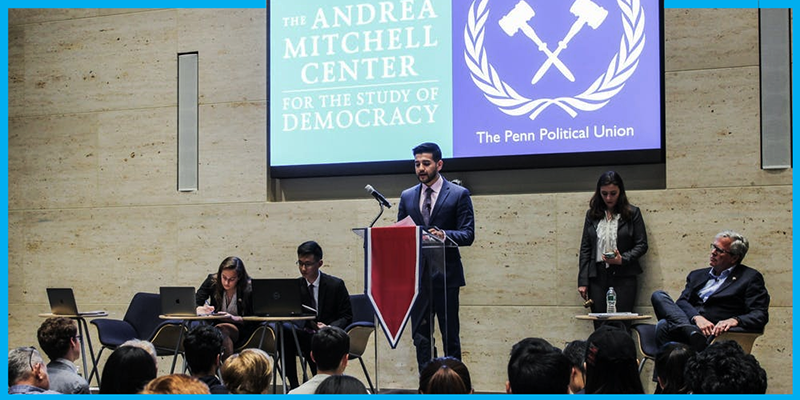
NEW (AND RETURNING) STUDENTS ARE ENCOURAGED TO ATTEND a debate by the Penn Political Union, followed by a Q&A for those interested in joining as members. The PPU is unique among debating societies in encouraging participants to make heartfelt cases for policies they believe in to a politically diverse group of fellow students. Members can join one of five caucuses that span the political spectrum: Progressive, Liberal, Centrist, Conservative, and Libertarian. They can then take active roles in formal debates on important policy problems. At a time of political polarization and social-media bubbles, it is an opportunity to hone and challenge one’s own opinions, as well as make friendships “across the aisle” and cultivate the practices of civil discourse. The PPU also welcomes prominent guest speakers throughout the year, whom members can question incisively from a variety of perspectives.
The debate topic will be on "Promoting Diversity, Equity, and Inclusion in Institutions."
PPU - A Welcome to New Students (and Others)
Class of 1978 Orrery Pavilion (Room 602)
Van Pelt-Dietrich Library Center
Please register here.
NEW (AND RETURNING) STUDENTS ARE ENCOURAGED TO ATTEND a debate by the Penn Political Union, followed by a Q&A for those interested in joining as members. The PPU is unique among debating societies in encouraging participants to make heartfelt cases for policies they believe in to a politically diverse group of fellow students. Members can join one of five caucuses that span the political spectrum: Progressive, Liberal, Centrist, Conservative, and Libertarian. They can then take active roles in formal debates on important policy problems. At a time of political polarization and social-media bubbles, it is an opportunity to hone and challenge one’s own opinions, as well as make friendships “across the aisle” and cultivate the practices of civil discourse. The PPU also welcomes prominent guest speakers throughout the year, whom members can question incisively from a variety of perspectives.
The debate topic will be on "Promoting Diversity, Equity, and Inclusion in Institutions."
